
.jpeg?w=1020&h=1020)
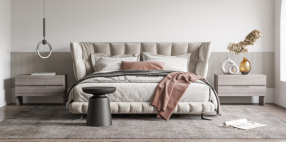

Every homeowner hits this moment somewhere between the second and third move. The flat-pack furniture is gone. The art isn't a poster anymore. The sofa is serious. And one evening you look up and realize the fixture above you is still the builder-grade drum shade that came with the house.
That's when the high-ticket lighting conversation starts.
A statement fixture isn't a $90 decision. Real chandeliers, hand-blown glass pendants, and sculptural floor lamps live in the $800-to-$3,000 range. The question isn't whether premium lighting is beautiful. The question is: when is it worth the money, and how do you pick the right one?
This guide is the framework we wish more first-time buyers had before clicking "add to cart" — the five-question test that separates a great investment from an expensive mistake, the sizing math that catches most people off-guard, and six Lighom fixtures worth studying across tiers.
Why Lighting Sits at the Top of the Upgrade Hierarchy
Before we talk about individual fixtures, it helps to understand why lighting deserves real money in the first place. Most people instinctively spend on sofas and dining tables before they think about overhead light. That's backwards.
Three reasons lighting punches above its weight:
1. It's on more hours than anything else you own. A dining chair gets used twenty minutes a day. The chandelier above it works four to six hours every evening. Over a decade, that fixture is "on" for longer than your furniture has been touched.
2. It dictates how every other thing in the room looks. Your walnut table looks cheap under a flat ceiling panel. Your $3,000 sofa looks like a mistake under cool-white LED. Lighting is the filter through which all other investments are seen — underspend here and you quietly devalue everything else.
3. It ages better than almost any other furniture category. Solid brass patinas. Hand-blown glass doesn't scratch. Real crystal doesn't fade. A $2,500 sofa needs reupholstery in a decade; a good chandelier doesn't. Cost-per-year, lighting wins.
A fixture chosen at 30 is often still right at 50. That's unusual.
The Five-Question Test: Before You Spend $1,000 on Any Fixture
Not every fixture in your home needs to be premium. In fact, buying premium everywhere is a mistake — you'll dilute the impact and drain the budget. The test below is what we recommend before pulling the trigger on any four-figure light.
1. Is it the first thing guests see?
Entryways, dining rooms, staircases, and main living rooms get photographed in memory. Bathrooms and laundry rooms don't. Put the money where it's seen.
2. Is it on for four or more hours per day?
If the answer is no, a mid-range fixture is fine. If the answer is yes, the difference between cheap dimming (flickery) and real dimming (silky) will be felt every single night.
3. Does the material age well — or age poorly?
"Chrome-plated" usually means plating that will pit. "Faux crystal" is often acrylic that yellows. "Brass-look" is often sprayed gold paint that flakes off a hot bulb housing within two years. At the premium tier, you should see: solid brass, copper, handcrafted Murano-style glass, real crystal (K9 or better), genuine ceramic. These materials don't just last — they improve.
4. Will it survive a style shift?
In ten years you may have repainted three times and changed three sofas. The lighting fixture might still be there. Pick a fixture whose silhouette reads well across traditional, modern, and transitional styling — not one so trend-specific that it pins the whole room to 2026.
5. Does it replace three or more items of "good enough"?
A $1,500 chandelier sounds expensive until you realize the alternative was three failed $300 fixtures over ten years plus the labor to install each one. Price per year is the only math that matters at the high end.
If a fixture passes three or more of these tests, it's a candidate. If it passes all five, buy it.
Category One: The Dining Room Centerpiece
If you only upgrade one fixture in your house, make it the one over the dining table. It is the single most-photographed piece of lighting in a home. Dinner parties, holidays, everyday breakfasts — it all happens under this light.
Two approaches work at the premium tier: architectural drama (long, low, linear — reads like a sculpture) or classical authority (large, round, historically-rooted — reads like heirloom).
Architectural drama — linear crystal
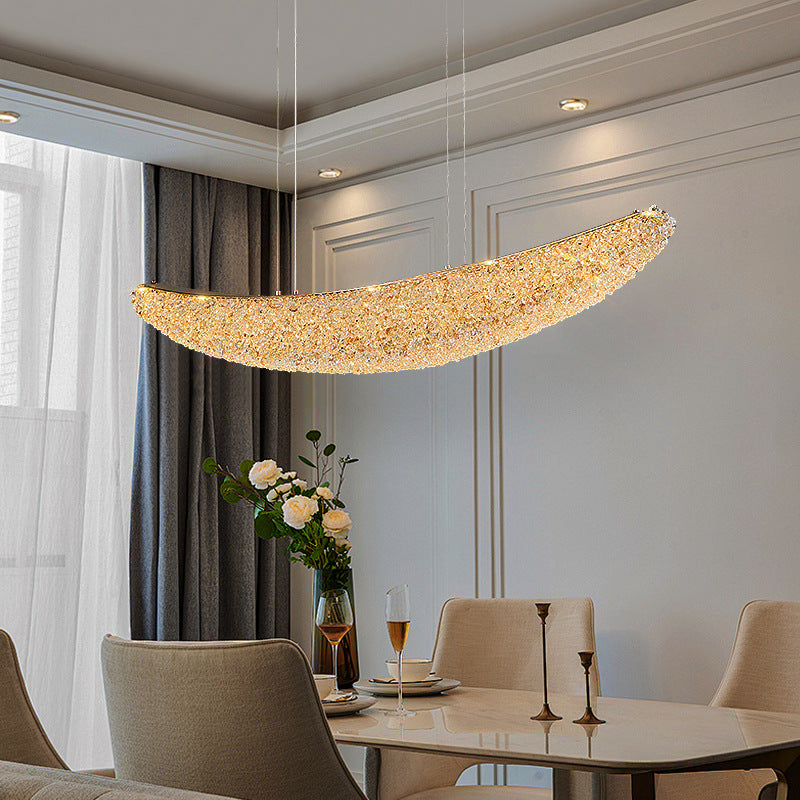
Modern Luxury Crystal Metal Banana-Shaped Boat LED Chandelier — $2,073
This is the modern answer to the dining centerpiece. The "boat" or "banana" silhouette solves a geometric problem most buyers don't realize they have — a round chandelier over a rectangular table always looks undersized. A linear piece matches the geometry below it and makes an eight-foot table feel intentional.
Integrated LED strips replace visible bulbs; crystal is tiered to refract rather than blind. At this tier you're paying for engineering as much as material: distributed weight, proper dimming driver, and hardware that survives a decade of steam and temperature swings.
Best for: rectangular tables 72" and longer, ceiling height 9'+, modern or transitional interiors.
Classical authority — handcrafted Italian
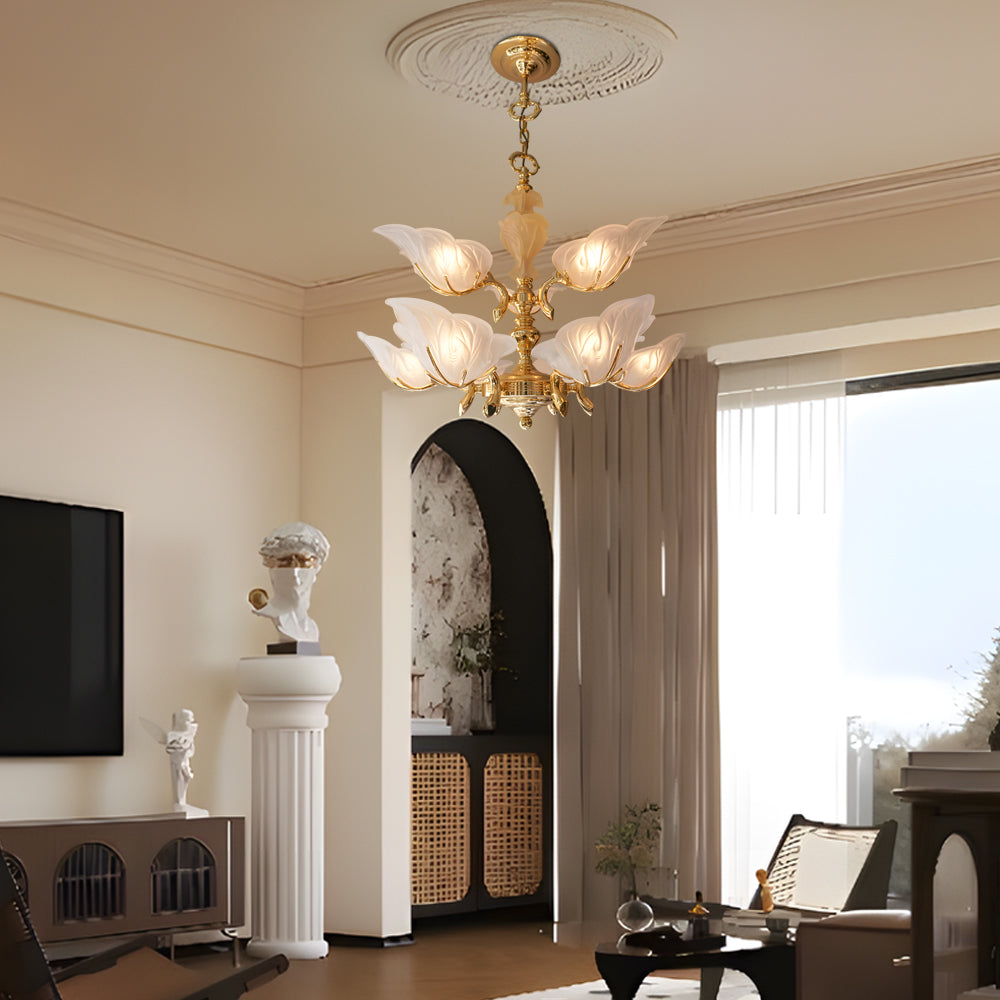
9-Light Italian Chandelier in Brass with Murano-Style Glass Leaves — $2,981
At the top of the range you're not buying a fixture — you're buying applied art that happens to produce light. The brass frame and hand-blown glass leaves echo Venini-era Murano glassmaking, where each leaf is formed in molten glass rather than cast. No two leaves are identical.
The honest case: this fixture will outlast the room you install it in. Brass is the only "gold-color" metal that doesn't pit or flake. Hand-blown glass leaves don't crack unless struck. The light is soft and directional — candle-warm rather than photographic-cool.
Best for: round tables 54" and up, formal dining rooms, homes with 10'+ ceilings, buyers looking for a piece they'll move between houses.
Category Two: The Living Room Grand Statement
The living room chandelier plays a different role than the dining fixture. In dining, the chandelier is centered over a fixed object (the table) and has a clear functional job (illuminate plates). In the living room, the fixture floats over a more abstract space — it becomes sculpture first and light source second.
This is the category where sentimental, historically-referenced fixtures earn their keep.
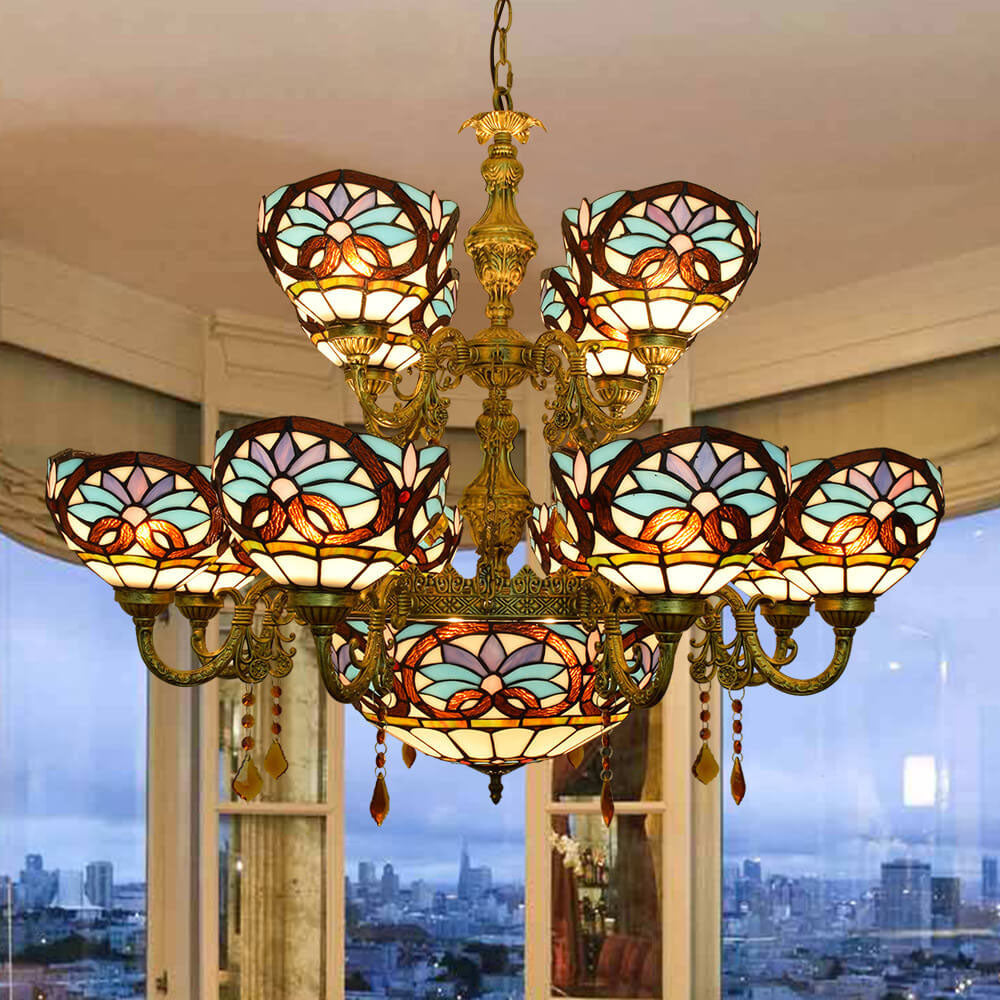
European Style Tiffany Love Baroque Stained Glass 15-Light Chandelier — $1,803
Stained-glass chandeliers carry historical weight. Tiffany's original Favrile pieces from the 1890s sell at auction for five and six figures — a reminder that genuine colored-glass lighting is an appreciating asset. This 15-light piece is a tribute rather than a reproduction: the dome is assembled from hand-cut glass panels in the original copper-foil technique Tiffany patented, not printed film over acrylic.
The effect is unmistakable. By day the dome reads as sculpture — muted greens, reds and golds catching ambient light. At night it throws colored pools across ceiling and walls, turning a white-box living room painterly. Not for minimalists. But in the right room, nothing else matches it.
Best for: living rooms with neutral walls, Craftsman or European-influenced interiors, buyers who want a fixture that doubles as decor during daylight hours.
Category Three: The Bedroom & Intimate-Space Chandelier
The common mistake with bedroom lighting is over-scaling. A bedroom fixture doesn't need to dominate — it needs soft, low-angle light without glare, and should look good from a prone position (you'll see it from bed more than anywhere else).
This is where textural, sculptural fixtures beat crystal or hard-edge metal.
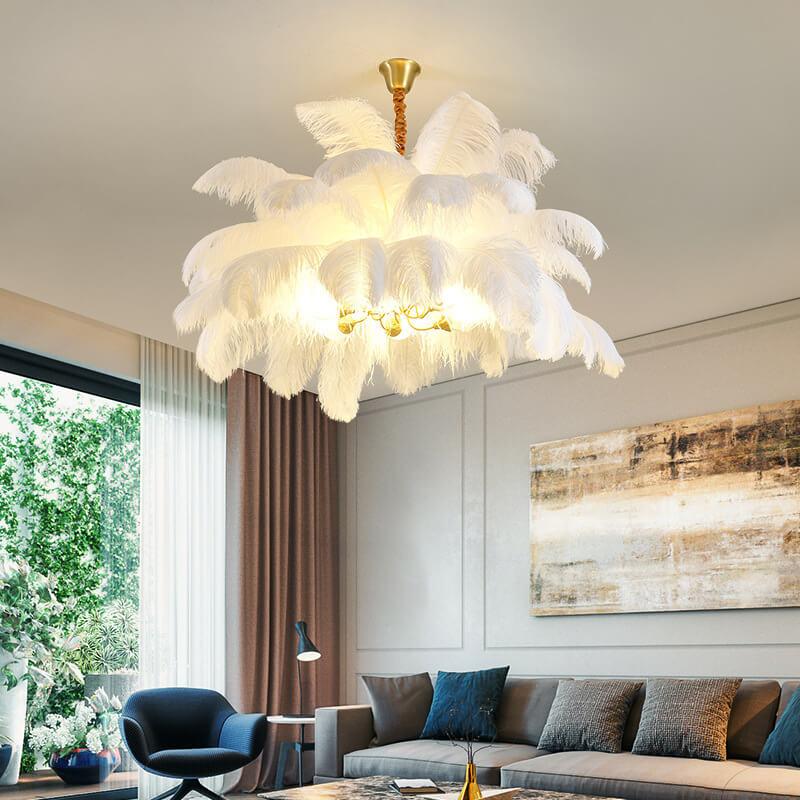
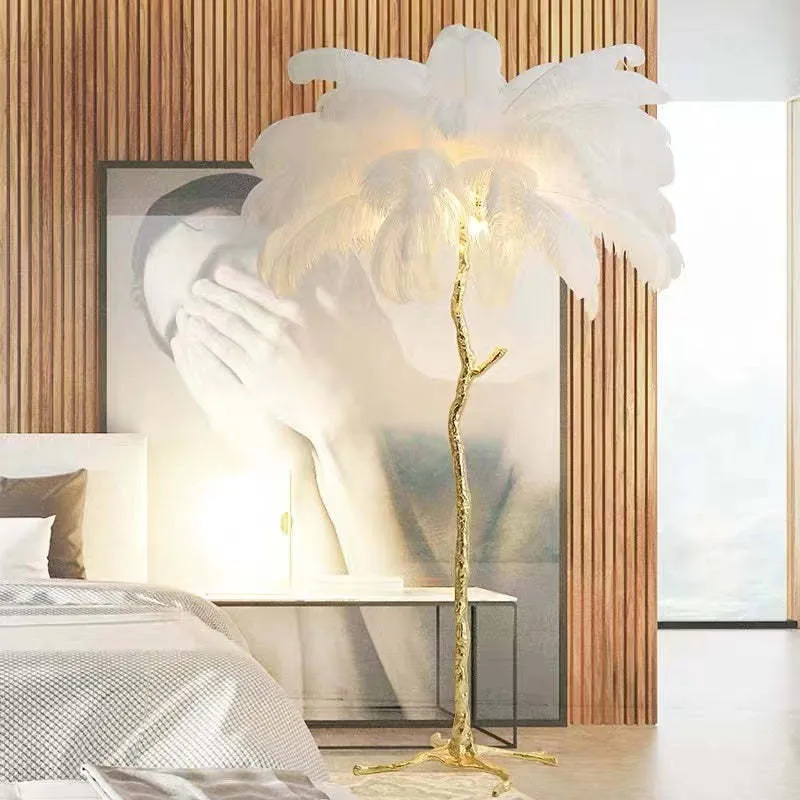
Modern Ostrich Feather 6-Light Brass Chandelier — $1,026
Feather fixtures are having a moment, and unlike most trend-driven lighting, they're earning it. Ostrich-plume diffusion does something no frosted glass or fabric shade can: it scatters light asymmetrically, softening shadows in a way that's flattering for skin, paintings, and the general mood of a bedroom. It's the lighting equivalent of a soft-focus camera filter.
The other thing this category gets right is sound. Feather fixtures are genuinely silent — no glass ringing, no metal ping when the HVAC kicks on. In a bedroom, that matters more than people realize.
The brass armature on this six-light is solid, not plated — which is important because a plated arm directly above a bulb gets heat-cycled nightly and will eventually flake. Real brass just deepens in color.
Best for: primary bedrooms, reading nooks, lounges. Ceiling height 8.5'+ so the feathers have room to read as a shape.
Category Four: The Dimming-First Fixture
If you cook, entertain, or work-from-home in the same room where you relax at night, dimming is not a feature — it's the whole point. The difference between a $200 fixture and a $1,000 fixture is almost always the dimming mechanism: PWM vs. analog, single-step vs. three-step or continuous, driver quality.
Three-step dimming — typically daylight, natural white, warm white — is the sweet spot for most buyers. It gives you meaningful range without the complexity of a smart-home setup.
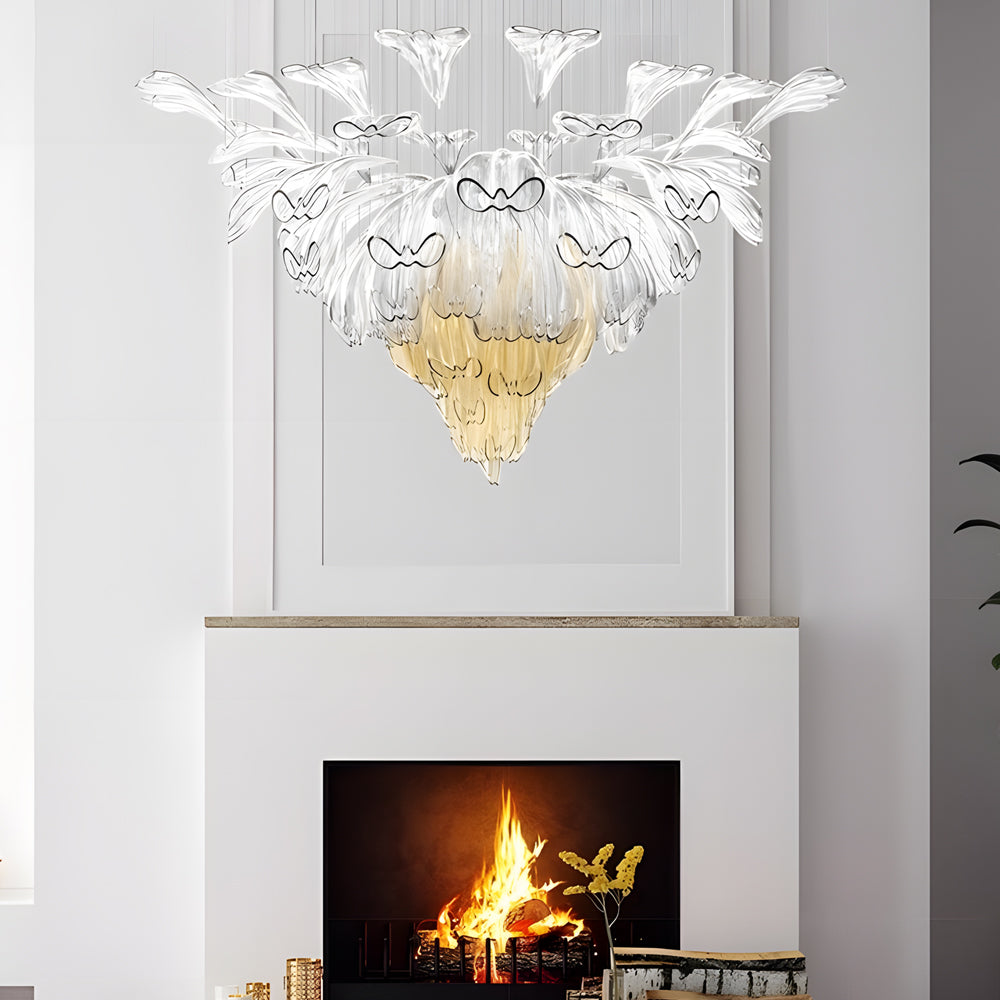
Luxury Flowers Handcrafted Art Glass 3-Step Dimming Modern Chandelier — $1,063
This is one of the more under-priced pieces in the Lighom range. The flower-form glass pieces are individually hand-shaped — each one has tiny asymmetries that read as intentional. And the three-step dimming works off a standard wall switch: tap it once for full brightness, twice for mid-tone, three times for the warm evening glow. No smart hub, no app, no extra wiring.
The color of the light at each step matters. Cheap dimming changes brightness but keeps the color temperature locked. Quality three-step dimming changes both, shifting from cool-bright (5000K) at step one to amber-warm (2700K) at step three. That's what makes the same fixture feel like three different rooms over the course of an evening.
Best for: open-plan living/dining spaces, home offices that double as evening rooms, buyers who don't want a smart-home setup but do want dimming range.
Category Five: The Outdoor Premium Piece
Most people underspend dramatically on outdoor lighting, then wonder why their $300 fixture is rusty and cloudy after three winters. Outdoor fixtures get more weather exposure in a year than indoor fixtures get abuse in a decade.
At the premium tier outdoors, you're paying for three things: real IP65 or better waterproofing (not IP44 pretending), corrosion-resistant hardware (316 stainless or powder-coated cast aluminum, not painted steel), and UV-stable acrylic or real tempered glass.
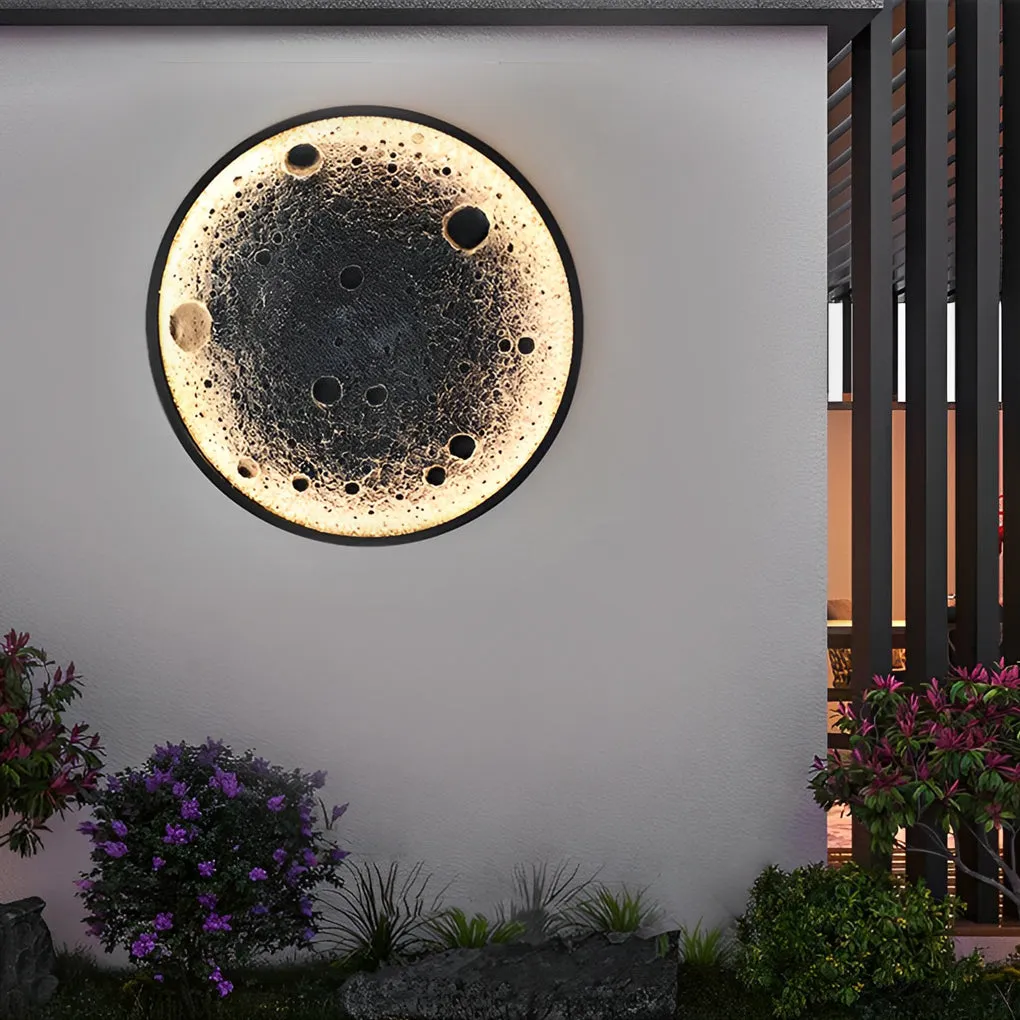
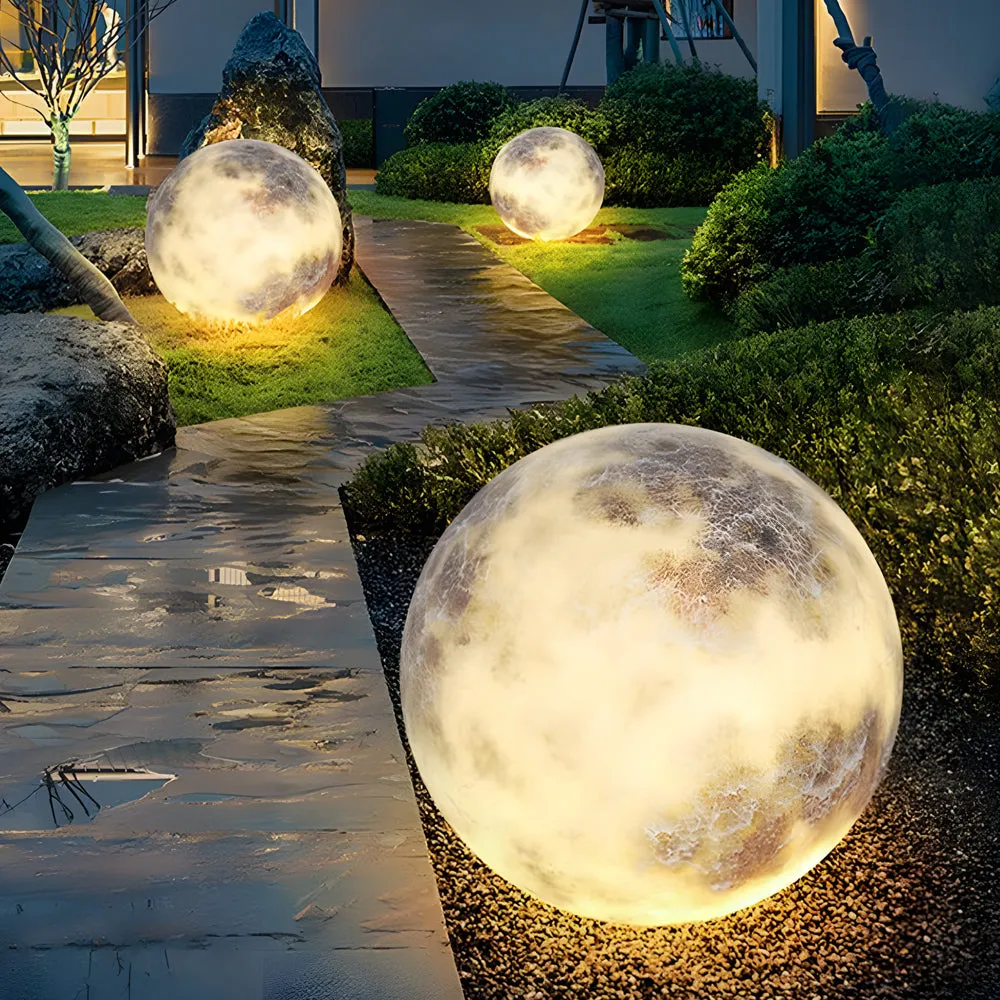
Round Moon Waterproof LED Modern Outdoor Wall Light — $588
This is the category's sleeper investment. For the price of a decent mid-range sofa, you get a fixture that turns the outside of a house into an architectural feature at night. The moon-globe form glows evenly from all angles thanks to internal LED distribution — there's no hot-spot or uneven patchiness that cheaper wall-mounted globes show when backlit.
The build spec is where the money goes: IP65 rated (full rain and dust resistance), cast-aluminum backplate that won't corrode in coastal air, and an LED module rated for 50,000 hours. At five hours a night, that's 27 years before the diode itself reaches end-of-life. You will almost certainly move house before this fixture dies.
Best for: entryways, patios, along garden paths, coastal or high-humidity climates where cheaper fixtures fail fastest.
Sizing Math: The Mistake Most First-Time Premium Buyers Make
The single most common regret with a new premium fixture is that it's too small for the room. Lighting catalogs photograph fixtures in isolation, and people instinctively underscale.
Use this math instead:
- Round chandelier over a round table: diameter of the fixture should be 50–65% of the table's diameter.
- Linear chandelier over a rectangular table: length of the fixture should be about 2/3 of the table's length.
- Entry / foyer fixture: add room length + room width in feet → that number, in inches, is your target fixture diameter. (A 12' x 15' foyer wants a ~27" diameter fixture.)
- Hanging height over a dining table: bottom of fixture 30–34" above the tabletop. Not above the floor. Above the tabletop.
- Living-room centerpiece: bottom of fixture at least 7' above the floor, ideally 7'6"+ if you walk under it.
If in doubt, size up. A fixture that is slightly too large reads as "generous." A fixture that is slightly too small reads as "mistake."
Material Cheat Sheet: What You're Actually Paying For
| What you see on the page | What you want it to mean | Red flag if it says |
|---|---|---|
| "Crystal" | K9 crystal or better — real lead-content glass that refracts | "crystal-look," "crystal-effect," "acrylic crystal" |
| "Brass" | Solid brass or brass-plated on heavy metal | "brass-tone finish" (usually sprayed paint) |
| "Glass shade" | Hand-blown or tempered glass | "glass-look resin" |
| "Genuine leather" (on lamp wraps) | Top-grain | "bonded leather," "leather-look" |
| "Dimmable" | Specifies the dimming type (3-step, 0-10V, TRIAC, smart) | "dimmable" with no further detail |
| "Outdoor rated" | IP65 or higher | "weather resistant" (meaningless) |
If the listing won't commit to specifics, the specifics are usually the thing they'd rather you didn't know.
Where to Save, Where to Spend
A quick counter-balance, because the right answer isn't "spend premium everywhere."
Save here: - Hallway flush mounts — barely seen, mid-range is fine - Laundry rooms, garages, utility spaces - Bathroom vanity lights (moisture kills premium finishes fastest) - Closet lighting
Spend here: - Dining chandelier (on 4+ hours a day, photographed constantly) - Living room centerpiece (largest visual surface in the home) - Primary bedroom (personal daily reward, lighting quality matters most for skin/mood) - Entryway / exterior fixtures visible from the street (curb appeal compounds) - Anywhere the ceiling is high enough to show the fixture from multiple angles
The pattern is simple: spend on fixtures that are seen often, from multiple angles, in spaces where mood matters. Save everywhere else.
The Bottom Line
Premium lighting isn't about status — it's about the math of daily use, how materials age, and pieces that outlast their rooms. Pick one fixture per home that earns the investment — usually the dining chandelier or living-room centerpiece — and let everything else rotate around it.
A great chandelier chosen at 35 is still right at 55. That's not true of most furniture.
The second time a guest walks into your dining room and stops, mid-sentence, to look up — you'll know it was worth it.
Explore Lighom's full Chandeliers collection, Outdoor Lighting and Table & Floor Lamps. All orders ship internationally free, with a 30-day satisfaction guarantee.