






You can usually feel a wrong-size chandelier before you can explain it. Too small, and it floats up near the ceiling like someone forgot to finish the room. Too big, and it leans over the space and makes the furniture look like it shrank in the wash. The good news is that “right” here isn’t really about taste — it’s mostly arithmetic. Once you know the two numbers that matter, you can stop guessing.
If you take only one thing from this: add your room’s length and width in feet, and shop for a chandelier roughly that many inches wide. Over a dining table, forget the room and size to the table instead. Everything below is just the detail behind those two moves.
Start with the room, not the ceiling
Most people look up at the ceiling and take a guess. Don’t — the ceiling decides how high you hang the fixture, not how wide it should be. Width comes from the floor.
So measure the length and width of the room in feet, add them together, and read that number as inches. A 12 by 14 foot living room gives you 26, which means a chandelier around 26 inches across will sit comfortably in the space. If you’d rather not do the math, here’s the shortcut:
| Room size | Chandelier diameter | Where it fits |
|---|---|---|
| 10 × 10 ft | About 20 in | Small entryway, home office |
| 12 × 12 ft | About 24 in | Bedroom, breakfast nook |
| 12 × 14 ft | About 26 in | An average living room |
| 14 × 16 ft | About 30 in | Large living or dining room |
| 16 × 18 ft | About 34 in | Open-plan or great room |
| 18 × 20 ft | About 38 in | Foyer or double-height space |
Caught between two sizes? Round up if the ceiling is tall and the room is grand, and round down if it’s a cozier space. When in doubt, slightly smaller almost always reads better than slightly too big.
Hanging height is where people slip up
You’ve got the width — now don’t hang it too low and clothesline your tallest guest. The baseline is simple: leave at least seven feet of clearance from the floor to the bottom of the fixture in any room people walk through. After that, give it a little more drop as the ceiling climbs, or it’ll look stranded up top.
| Ceiling height | Bottom of chandelier | Worth knowing |
|---|---|---|
| 8 ft | About 7 ft off the floor | Standard walking clearance |
| 9 ft | 7 ft to 7 ft 6 in | A little extra drop looks deliberate |
| 10 ft | 7 ft 6 in to 8 ft | Add roughly 3 in of drop per extra foot |
| Two-story foyer | Level with the second floor | Keep it above the door line from outside |
One exception: if you’re working with a flat 8-foot ceiling and a hanging fixture would crowd the room, skip the drop entirely and go with a flush or semi-flush fixture. You keep the decorative moment without losing headroom.
Above a dining table, the rules change
This is the one spot where the room formula goes out the window. Over a table, the chandelier answers to the table — aim for something between half and two-thirds the table’s width, and hang the bottom 30 to 36 inches above the surface (lower for low ceilings, higher if you’ve got nine feet to play with).
| Table width | Chandelier width | Seats |
|---|---|---|
| 36 in | 18–24 in | 4 |
| 42 in | 22–28 in | 4–6 |
| 48 in | 24–32 in | 6 |
| 60 in | 30–40 in | 6–8 |
Long, rectangular tables are the classic trap. A single round chandelier tends to look undersized over them, and two small ones often look better than one. A linear or island-style fixture is usually the cleaner answer, and it spreads light evenly down the length of the table instead of pooling it in the middle. If you’re still choosing the table itself, it’s worth sizing both together — here are our dining tables.
A few real rooms, for reference
Numbers are easier to trust with examples, so here are four common ones:
- A small entryway, 8 by 10 feet with 9-foot ceilings: about an 18-inch fixture, hung high enough to greet people without blocking the view in.
- A typical living room, 13 by 15 feet: roughly 28 inches, centered, ideally on a dimmer.
- A primary bedroom, 12 by 13 feet: around 24 inches — and honestly, sizing it a touch under the formula keeps the room calm rather than busy.
- A two-story foyer: go tall and multi-tier, size to the bigger formula number, and hang it level with the upstairs landing.
Then pick something you’ll still like in five years
Once the size is settled, the look is the fun part — and the easy mistake is chasing a trend you’ll be sick of by next spring. A few directions that tend to age well:
- Modern chandeliers in metal or acrylic, for clean, contemporary rooms.
- Crystal chandeliers when you want a little formality and sparkle, usually in dining rooms and entryways.
- Glass chandeliers for soft, diffused light that doesn’t dominate the ceiling.
Whatever you land on, echo a finish that’s already in the room — a metal from your cabinet hardware, a tone from the furniture — and the fixture will look like it was always meant to be there.
Questions people actually ask
Can a chandelier be too big?
Definitely, and it’s the more common mistake. An oversized fixture crowds the ceiling and shrinks the room. If you’re between sizes on a normal ceiling, take the smaller one.
My ceiling is only 8 feet — am I stuck?
Not at all. Use a flush or semi-flush fixture instead of a long drop. You keep the decorative look and your headroom.
Is a chandelier okay in a bedroom?
It can be lovely, as long as you keep the scale modest and the clearance sensible. Slightly under the room formula is the move.
What about over a kitchen island?
Treat the island like a table: the fixture, or the combined spread of two or three pendants, should cover about half to two-thirds of its length.
Measure once, trust the numbers, and the rest is just picking something you love. When you’re ready, here’s the full range of chandeliers.
Shop these chandeliers
 Nordic Iron Cloud Starry LED ChandelierShop now →
 Plant Vine Decorative 3-Light ChandelierShop now →
 Luxury Glass Icicle Droplet Crystal ChandelierShop now →
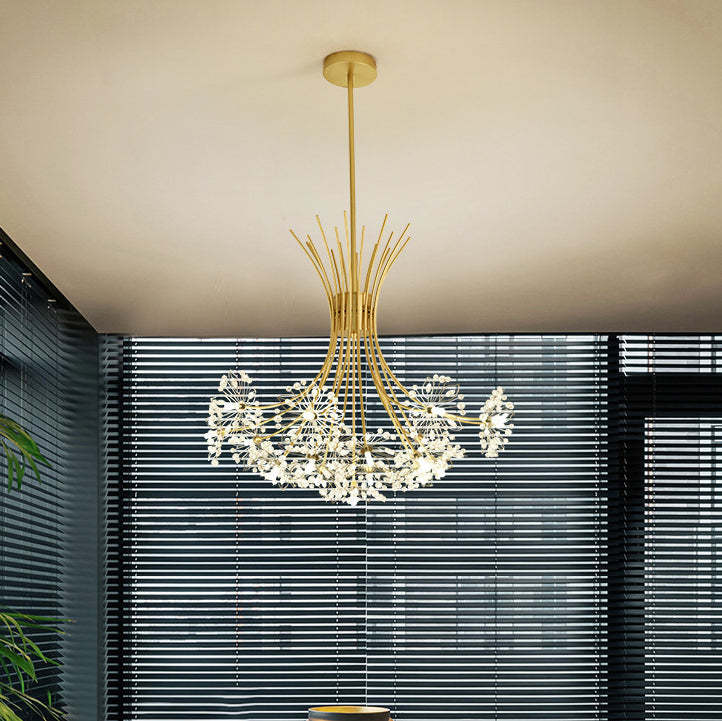 Dandelion Crystal Firework Iron Frame ChandelierShop now →
 European Brass Glass Floral ChandelierShop now →